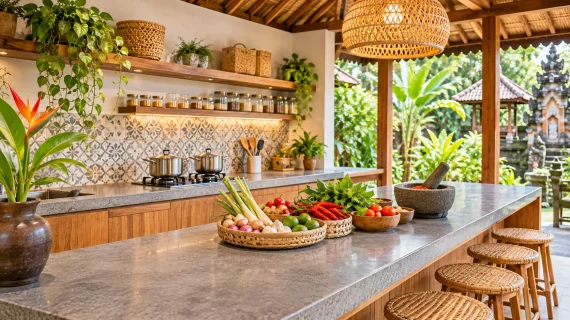
A cooking class kitchen has to do something an ordinary home kitchen rarely does: accommodate several people preparing food, learning new techniques, and moving around the same workspace at once.
In Bali, this becomes particularly interesting. A cooking class might take place in a modern villa, a purpose-built culinary studio, or a traditional family compound. Each setting offers a different atmosphere, but all require thoughtful decisions about layout, flooring, countertops, ventilation, and washing facilities.
For property owners considering a culinary tourism business, the kitchen should be planned around how people will actually use it. Beautiful finishes matter, but they cannot compensate for crowded walkways, slippery floors, or poorly positioned preparation areas.
This guide explains how to design a cooking class kitchen that balances practicality, safety, maintenance, and Balinese character, with particular attention to building materials suitable for Bali’s tropical environment.
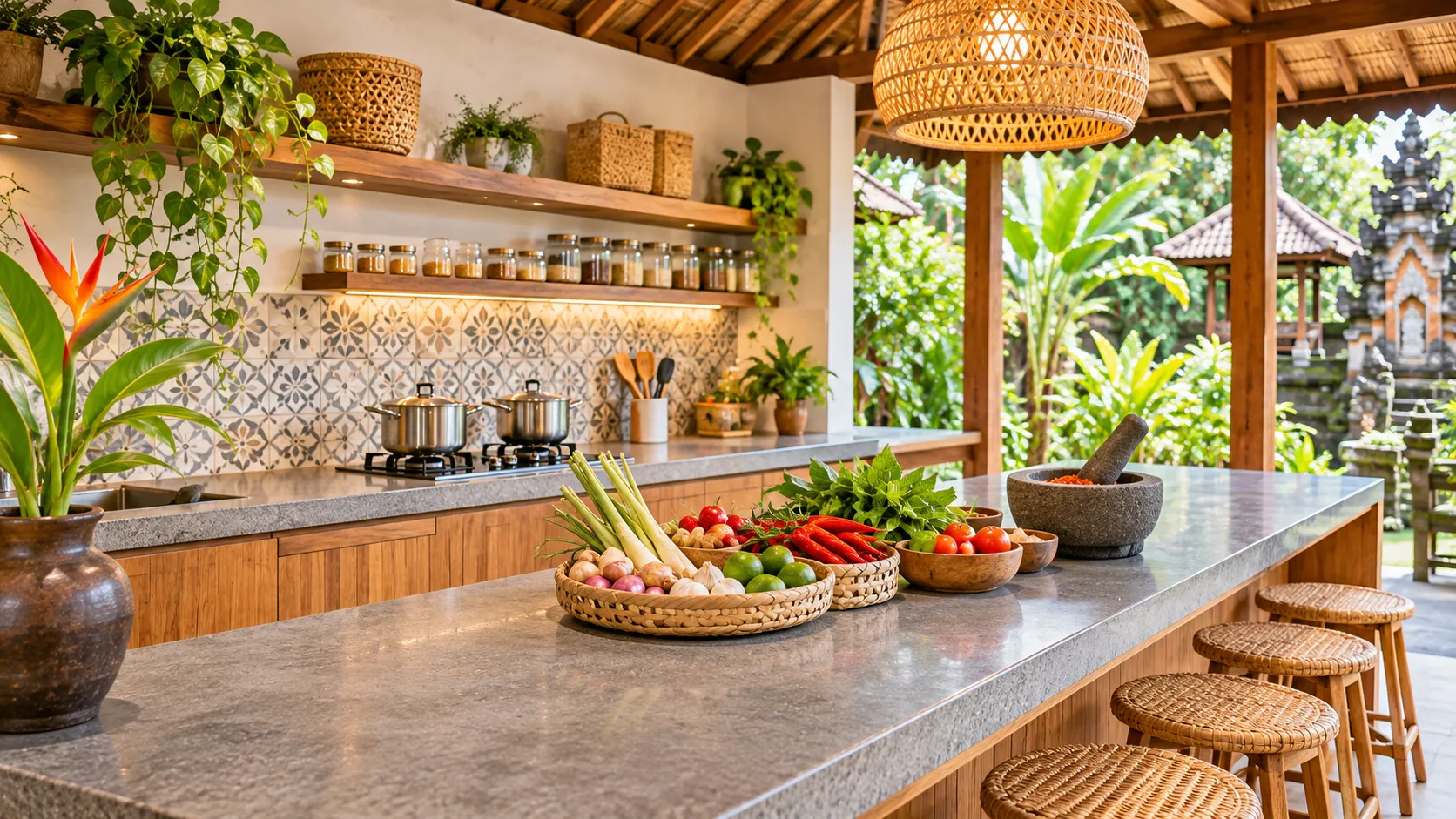
1. Understand How a Cooking Class Kitchen Works
The first mistake in cooking class kitchen design is treating the space like a typical residential kitchen.
In a family home, one or two people may prepare meals while everyone else stays outside the cooking area. During a hands-on class, participants need room to chop ingredients, mix spices, observe demonstrations, and sometimes cook simultaneously.
Before choosing tiles or countertops, identify the activities the kitchen must support.
A typical cooking session may involve:
- Welcoming guests and introducing ingredients.
- Washing vegetables and preparing raw materials.
- Chopping, grinding, and mixing spices.
- Demonstrating cooking techniques.
- Allowing participants to practice under supervision.
- Cooking, plating, and serving the finished dishes.
- Cleaning utensils and preparing for the next session.
Every activity requires space, but not every activity needs a separate room.
The objective is to create a logical sequence that keeps unnecessary movement to a minimum.
2. Plan the Kitchen Around a Practical Workflow
A useful cooking class layout starts with four functional zones: preparation, demonstration, cooking, and washing.
Preparation zone
This is where ingredients are measured, chopped, and arranged before cooking begins. Worktops should provide sufficient space for cutting boards, mixing bowls, and utensils without forcing participants to crowd around one table.
Demonstration zone
The instructor needs a position where participants can see essential techniques. For example, grinding Balinese spices with a traditional stone mortar is easier to teach when everyone has a clear view.
Cooking zone
Stoves, hot pans, and other heat-producing equipment should be positioned away from the busiest pedestrian routes. Avoid layouts that force guests carrying ingredients to walk behind someone handling a hot pan.
Washing zone
Cleaning facilities should be accessible without creating congestion around the preparation and cooking areas.
For a small private class with six participants, a designer might evaluate two shared preparation stations and a separate instructor demonstration area. This is only an illustrative starting point; the final capacity depends on equipment, available floor area, accessibility, and operating procedures.
Before construction begins, mark the intended zones on a floor plan and simulate an entire class from arrival to cleanup.
3. Choose Kitchen Flooring for Wet and Busy Conditions
Flooring is one of the most important building-material decisions.
During a cooking class, water may splash near sinks, vegetable scraps may fall during preparation, and cooking oil can occasionally reach the floor.
A polished tile that looks attractive in a showroom may become difficult to walk on when wet.
For cooking areas, prioritize floor finishes with suitable slip resistance and good cleaning characteristics.
Textured ceramic or porcelain tiles may be appropriate, depending on the product’s tested performance, installation requirements, and expected conditions.
Consider these factors when comparing flooring:
- Slip resistance: Ask suppliers for product-specific wet-slip performance information rather than relying on labels such as “anti-slip.”
- Cleanability: Deep decorative grooves can trap food residue and make daily cleaning more difficult.
- Durability: The surface must withstand frequent movement, washing, and normal kitchen equipment.
- Drainage: Wet areas should be designed to prevent standing water.
- Joint maintenance: Grout and tile joints should be accessible for cleaning and repair.
Not every expensive tile is appropriate for a working kitchen.
Depo Bagoes has an existing guide explaining the differences between ceramic and porcelain tiles, which provides useful background when comparing material options.
For any teaching kitchen, the final flooring specification should reflect actual slip-test data and the advice of a qualified designer or installer.
4. Select Countertops That Can Handle Daily Food Preparation
A cooking class countertop is not merely a decorative surface.
Participants may place heavy stone mortars on it, work with turmeric and chili, prepare wet ingredients, or repeatedly clean the area between activities.
The ideal surface should be durable, easy to maintain, and appropriate for the intended food preparation process.
Several materials deserve consideration.
Stainless Steel
Stainless steel is commonly used in professional food preparation environments because it offers a smooth, nonporous surface that can be cleaned effectively when properly maintained.
It is particularly practical around wet preparation stations and washing areas.
However, it may not provide the warm appearance desired in a traditional Balinese kitchen.
Engineered Stone and Suitable Solid Surfaces
Some engineered stone and solid-surface products offer attractive finishes with relatively straightforward cleaning requirements.
Their suitability depends on the specific product, including resistance to heat, staining, chemicals, and impact.
Hot cookware should never be placed directly on a surface unless the manufacturer confirms that it can tolerate the intended temperature.
Natural Stone
Granite and other natural stone finishes can contribute to a distinctive appearance, but their maintenance requirements vary.
Porous materials may require sealing, and surface treatments must be appropriate for food preparation.
For larger cooking class facilities, using different materials in different zones may be more practical than installing one premium surface throughout the entire kitchen.
5. Choose Backsplash Materials That Are Easy to Clean
The backsplash protects walls behind sinks, cooking equipment, and preparation areas.
In a kitchen where guests repeatedly prepare spices, the wall may be exposed to turmeric stains, oil droplets, and moisture.
Glazed ceramic tiles can be a practical option because many have relatively easy-to-clean surfaces.
The important details are not only the tiles themselves but also the grout, edge finishing, and quality of installation.
Small decorative tiles with numerous joints may look beautiful, but they generally require more detailed cleaning.
Larger tiles can reduce the number of grout joints, although the final choice should accommodate the wall dimensions and installation conditions.
For additional inspiration, Depo Bagoes also discusses backsplash and worktop ideas in its article on creative kitchen design.
A useful approach is to choose simple, cleanable surfaces around the busiest work areas and reserve decorative finishes for locations away from heavy splashing.
6. Prioritize Water Supply, Handwashing, and Drainage
A cooking class kitchen handles more than cooking utensils.
Guests wash their hands, ingredients need proper preparation, and equipment must be cleaned between different activities.
This makes the water system an essential part of the building plan rather than a detail to resolve after the cabinets are installed.
Provide suitable handwashing facilities and enough washing capacity for the operation. Food preparation and equipment cleaning should be organized to reduce the risk of cross-contamination.
For renovation projects, check the condition and capacity of existing supply pipes, drainage connections, and wastewater arrangements before selecting sink locations.
Where floor drainage is required, ensure that the design includes appropriate gradients, drainage traps, and accessible maintenance points.
The kitchen layout should also support safe handling of raw and ready-to-eat ingredients.
Equipment, finishes, and cleaning procedures need to satisfy the applicable requirements for the business.
7. Design Ventilation for Bali’s Tropical Climate
Heat and humidity can affect comfort inside a kitchen, particularly when several cooking stations operate simultaneously.
In a tropical environment such as Bali, ventilation deserves careful planning.
Traditional open-sided kitchens may benefit from natural airflow, but this does not automatically guarantee adequate smoke or heat extraction.
A cooking class operating multiple burners may require mechanical extraction designed for the equipment and cooking methods used.
Consider the following questions:
- Where will heat, steam, and cooking fumes travel?
- Is there enough replacement air when extraction equipment is operating?
- Will the instructor’s demonstration position remain comfortable?
- Can airborne rain, insects, and outdoor dust enter food preparation areas?
- Are electrical installations protected from water and excessive heat?
Electrical circuits, gas equipment, and extraction systems should be designed and installed by qualified professionals.
Avoid positioning exhaust outlets where they may disturb neighboring properties or return fumes into guest areas.
8. Preserve Balinese Character Without Sacrificing Function
A cooking class in Bali offers something more than a technical cooking lesson.
For many visitors, the setting is part of the experience.
Traditional tools, locally familiar materials, natural textures, and spaces that encourage conversation can give a kitchen a sense of place.
However, cultural character does not require every surface to be made from traditional materials.
A thoughtful design might combine easy-to-clean preparation counters with timber accents, traditional cooking utensils, and a separate area for explaining local ingredients.
Natural stone, bamboo details, and Balinese architectural elements can provide visual warmth where they are suitable and properly maintained.
The key is to distinguish decorative areas from surfaces exposed to heavy food preparation.
A beautiful kitchen should still be practical after several consecutive cooking sessions.
9. Learn From Real Balinese Home Cooking Experiences
Before designing a cooking class kitchen, it can be valuable to observe how people interact during an actual cooking lesson.
A cooking class inside a family home offers a different perspective from a commercial demonstration kitchen.
Guests often gather around fresh ingredients, watch traditional spice preparation, and participate in individual cooking tasks while learning about the culture behind the recipes.
For example, Ubud Cooking Class with Putu takes place in a Balinese family compound in Pejeng, near Ubud.
Visitors learn to prepare five Balinese dishes using local ingredients and traditional cooking techniques before enjoying the meal they have made together.
The experience highlights an important principle for anyone developing a culinary tourism facility: the relationship between instructor and participants is just as important as the equipment.
A kitchen that encourages conversation, clear demonstrations, and comfortable participation can create a more meaningful experience than an expensive space that makes interaction difficult.
Property owners exploring the atmosphere of a Balinese cooking experience can also view Cooking Class Ubud on Instagram for a closer look at the cooking activities, ingredients, and cultural setting.
These experiences can inspire design ideas, although any new business kitchen still needs its own professional assessment for capacity, hygiene, and safety.
10. Build a Realistic Kitchen Construction Budget
Kitchen construction costs depend on the condition of the existing building, the size of the project, the required utilities, and the quality of selected materials.
Instead of beginning with decorative finishes, organize the budget into essential categories.
| Budget category | What to include |
|---|---|
| Building preparation | Structural assessment, repairs, partitions, and waterproofing |
| Flooring | Tiles, adhesives, grout, installation, and drainage details |
| Work surfaces | Countertops, supports, and preparation stations |
| Plumbing | Water supply, sinks, drains, and wastewater connections |
| Electrical and ventilation | Circuits, lighting, extraction, and installation |
| Storage | Cabinets, shelves, and equipment organization |
| Finishing | Backsplash, wall finishes, and decorative elements |
Request an itemized quotation rather than relying on a single estimated construction price.
For renovation projects, it is also sensible to reserve a contingency allowance for concealed plumbing problems, damaged substrates, or other conditions discovered during construction.
The appropriate amount depends on the project’s risk and condition; it should not be treated as a fixed percentage for every building.
11. Test the Layout Before Opening
A completed kitchen is not necessarily ready for a cooking class.
Before welcoming paying guests, conduct a practical trial using the intended equipment and a realistic number of participants.
Ask several people to follow the proposed class sequence.
Observe whether they can move comfortably, see demonstrations, access handwashing facilities, and prepare ingredients without interfering with someone else.
Pay special attention to congested corners, hot surfaces, wet flooring, storage access, and the distance between preparation stations and sinks.
Make changes while they are still relatively easy to implement.
A modest adjustment to a worktable position can sometimes improve the experience more than a costly decorative upgrade.
Frequently Asked Questions
What is the best flooring for a cooking class kitchen?
A suitable floor should be easy to clean, durable, and have documented slip resistance for the expected conditions. Textured ceramic or porcelain products are possible options, but selection should be based on the specific product and installation design.
Can a traditional Balinese kitchen be used for cooking classes?
A traditional setting may be suitable for certain teaching activities, but suitability depends on the actual layout, equipment, sanitation facilities, safety measures, and applicable business requirements. Cultural authenticity alone does not establish operational compliance.
Is a cooking island necessary?
Not necessarily. An island can create a useful demonstration area, but smaller kitchens may function better with shared preparation tables or a wall-based layout. Adequate clearance and safe circulation matter more than following a particular design trend.
What should be planned before buying kitchen materials?
Confirm the expected number of participants, cooking equipment, workflow, utilities, drainage, ventilation, and cleaning requirements first. These decisions determine which materials and installation methods are appropriate.
Final Thoughts: Design for the People Using the Kitchen
A successful cooking class kitchen begins with a practical understanding of how guests and instructors work together.
Safe flooring, durable preparation surfaces, sensible storage, good ventilation, and dependable washing facilities are the foundation. Architectural character and decorative details can then make the space memorable without interfering with daily operations.
For homeowners, villa operators, and culinary entrepreneurs in Bali, planning these details early can help prevent unnecessary renovation costs later.
Depo Bagoes Bangunan serves customers in Gianyar and surrounding Bali areas through its building-material stores in Bedulu and Celuk. Before purchasing materials, discuss the intended application, installation conditions, and current product specifications with the store team.
The best kitchen is not simply the one that looks impressive in photographs. It is the one that remains comfortable, functional, and easy to maintain after the guests have finished cooking.